Language Translator

Wednesday, February 21, 2024

Facts About Esau Everyone Should Know

February 21, 2024

He Was the Son of Isaac

Isaac, the son of Abraham, was married to Rebecca for many years before being blessed with children. Finally, after 20 years of marriage, they were blessed with twin boys, Jacob and Esau.


Read: Esau’s Autobiography


 He Had Three Names

When Esau was born, he was fully formed and had hair across his body like a full-grown man. This prompted all those present to give him the name Esau (Esav in Hebrew), which translates as made or formed.


At the age of 15, Esau was given a second name, Edom, Hebrew for red. The impetus for this name was his foolhardy decision to sell his birthright to Jacob in turn for a pot of red lentil soup (see below) This name was also associated with the reddish complexion of his skin, which symbolized his propensity for violence.


Some say that Seir, Esau’s residence (see below), was yet a third name of his, after his hairy appearance (hair is se’ar in Hebrew).


 He Was the Eldest

Esau was the older twin. Scripture relates that when leaving their mother’s womb, Jacob grasped Esau’s heel, as if to delay his birth.


The Midrash relates that Jacob was actually created from the first drop of semen, while Esau was created from the second. Similar to two spheres in a tube, in which the one inserted last exits first, Esau exited Rebecca’s womb first, and Jacob exited second. From this perspective, Jacob was essentially the firstborn. This is why he tried to delay his brother’s birth, so that he would be born first just as he was created first.5


Read: Jacob and Esau


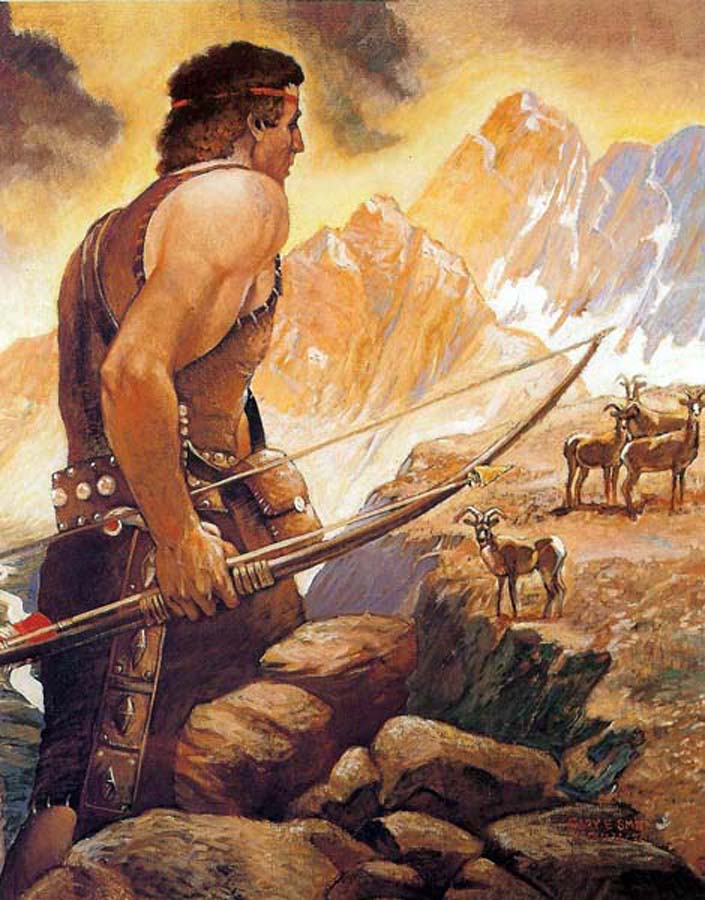
He Was a Hunter

While Jacob was an ardent student, Esau was more inclined to spend his days in the fields, hunting animals and birds.6 It is told that Nimrod, a master hunter himself, was in possession of a cloak that had been passed down from Adam, which attracted wildlife when worn, facilitating his hunting abilities. Esau strongly desired this cloak, to the extent that he plotted against Nimrod, murdering him and securing the cloak for his personal use.7


His Father Loved Him

While Rebecca favored Jacob, Isaac showed a preference to Esau, as Esau would prepare him delicious meals.8 The Midrash adds that Esau tricked his father by leading him to believe that he was pious. One way he did this was by asking Isaac detailed questions involving Jewish law, such as whether it was necessary to separate tithes from salt and straw.9


Read: Why Did Isaac Love Esau?


He Sold His Birthright

One day, 15-year-old Esau returned home after a long day of hunting. (Our Sages add that it was the day he had murdered Nimrod—see above.) Weary and hungry, he encountered his brother cooking a pot of red lentils. Jacob was planning to give the dish to his father, who was mourning his father Abraham, who had passed away that very day.


When Esau asked Jacob for a portion of stew, Jacob stipulated that he would only share it with him if Esau would sell him his birthright. Knowing the special status Judaism accorded the firstborn, he did not want it to be bestowed upon a wicked person like Esau. Esau agreed. He sold his birthright and was duly given a lavish meal of bread and lentil soup.10


Read: Beans and Birthrights


He Married at 40

At the age of 40, Esau married two Canaanite women: Adah, daughter of Elon the Hittite; and Ahalivamah, daughter of Tzivon the Hivite.11 His wives made his parents miserable, blatantly sacrificing incense to pagan deities.


Twenty-three years later, he married a third wife—his first cousin, Basmat, daughter of his uncle Ishmael.


Read: Esau and His Wives


Jacob “Stole” His Blessings

The friction between the two brothers escalated one spring day, when the elderly, blind Isaac instructed Esau to hunt some game and prepare it for him, after which he would bless him. Wanting Jacob to receive the blessings, Rebecca prepared a dish of goat meat and instructed Jacob to masquerade as Esau. Jacob did as he was instructed, and indeed received his father’s blessings.


When Esau discovered what had happened, he was furious at Jacob and wanted to kill him, forcing his brother to flee the home. Jacob spent 20 years at the home of his uncle Laban in Haran, who also became his father-in-law when Jacob married his daughters Leah and Rachel.14


Read: Was Jacob Right to Take the Blessings?


He Later Made Peace With Jacob

After many long years, Jacob finally made his way home, only to be told that his brother was marching towards him with a large army. Alarmed, Jacob prepared for war, prayed to God, and sent gifts to appease Esau. When they finally met, Esau fell on his brother’s neck and kissed him, and finally, the brothers were at peace—or at least so it seemed.


There are various opinions among the Sages as to what truly happened. Some say that he was overcome with compassion—at least temporarily—and kissed Jacob wholeheartedly, while others say that the kiss was half-hearted. Yet others say that his real intent was to bite him at the neck, but G‑d miraculously thwarted his plans by causing Jacob’s neck to become stiff like marble.16


Read: Why Does Esau Hate Jacob?


He Lived on Mount Seir

While Jacob was in Haran, Esau acquired an estate in the land of Seir, then inhabited by the Horites. After his brother’s return, he decided to employ more drastic measures. Taking his family with him, he returned to Seir and waged battle against the Horites, conquering their land. From then on, Mt. Seir became the homeland of Esau’s descendants, known as the nation of Edom.


On their way from Egypt, the Israelites wanted to cross Mt. Seir on their way to the Promised Land, but the Edomites stubbornly refused, forcing the Jews to take a circular route.


His Head Is Buried Near Jacob

The fates of Esau and Jacob merged even at death. Jacob passed on in Egypt, and his body was taken by his sons to be buried in the Cave of Machpelah in the Land of Canaan. To their consternation, however, there was Esau, laying dubious claims to the last remaining plot in the cave. While the quick-running Naftali was dispatched to retrieve the bill of deed, Hushim, the hard-of-hearing son of Dan, inquired as to the cause of the delay. When he was informed that it had to do with his uncle Esau, he dealt him a mighty blow that brought about his demise.


Midrashic sources further state that Esau’s head (severed from the blow) rolled into the Cave of Machpelah until it reached the bosom of his father Isaac, and was buried there.20


Read: The Beheading of Esau


He Is Considered the Progenitor of Rome

Esau’s offspring split into various groups, each one led by a chieftain. One of these groups was named Magdiel, which is identified as Rome. Indeed, there is a longstanding tradition that the Romans were descendants of Esau, and as such, Jewish literature refers to the Roman Empire as the Kingdom of Edom.


Obadiah Compared Him and His Brother to Straw and Fire

Esau was Jacob’s antithesis even while still in their mother’s womb. Experiencing a difficult pregnancy, Rebecca consulted Shem son of Noah, who conveyed to her the word of God.


Two nations are in your womb, and two kingdoms will separate from your stomach. One nation will [alternatingly] be stronger than the next, but [ultimately] the older one will serve the younger one.


The friction between the brothers continued with their descendants for millennia. The prophet Obadiah foretells how this twin-brother drama will conclude:


The house of Jacob will be likened to fire; the house of Joseph, to a flame; and the house of Esau, to straw. They will ignite them and consume them…. Saviors will ascend the mountain of Zion to judge the mountain of Esau, and sovereignty will be to God.


 He Had Deep Spiritual Potential

Chassidic thought gives deeper insight into Esau’s personality and Isaac’s seemingly misled favoritism. Isaac was aware of Esau’s true character, but he also knew that he possessed deep spiritual powers waiting to be unleashed in a positive way. This is also why he planned to bless Esau, hoping this would draw out his hidden potential.


Although the time was not yet ripe, in later generations, Esau’s lofty spiritual source would come to fruition. A number of famous converts traced their lineage to him, among them the prophet Obadiah, Onkelos, and Rabbi Meir. (In fact, Esau himself had the status of a Jew, albeit one who rebelled against God, Moreover, Kabbalistic texts teach that in the Era of Moshiach, Esau and his descendants will be transformed and embrace goodness and holiness.

Sunday, February 18, 2024

Remove The Ways of Cain

February 18, 2024

 The word Cain means: Possessions. Cain ground keeper

The word Abel means: Breath: Abel was the keeper of sheep


Cain was one of the sons of Adam and Eve. His birth is the first one recorded in Scripture, leading us to believe that Cain was Adam and Eve’s firstborn: “Adam made love to his wife Eve, and she became pregnant and gave birth to Cain. She said, ‘With the help of the Lord I have brought forth a man’” (Genesis 4:1). The name Cain is based on the Hebrew root word qanah, which means “possession.” Cain was a rebellious man who rejected God’s plan, ignored God’s warnings, and received God’s judgment.


Cain is most infamous for being the world’s first murderer. When his sacrifice was rejected by God while his brother Abel’s was accepted, Cain grew angry (Genesis 4:4–5). God warned Cain against further sin, but Cain spurned God’s warning and killed his brother Abel in a field (verses 6–8). God punished Cain by increasing his hardship and banishing him from society (verse 10–12). But God also marked Cain in some way to protect him from being killed by revenge-seekers (verse 15). Cain settled in the land of Nod, east of Eden, married a sister (or cousin or niece), and had descendants that are listed in the Bible to the sixth generation. Cain built a city (verse 17), and his descendants included nomadic herdsmen, musicians, and smiths (verses 20–22).


Cain’s descendants, some of whom are listed in Genesis 4, grew more and more wicked. Lamech, the fifth from Cain, was a polygamist and a murderer, and he boasted of his sin (Genesis 4:23). All of Cain’s seed were probably wiped out in the flood. Genesis 5 follows the more godly line of Seth, one of Cain’s younger brothers. Seth’s descendants included Enoch, Methuselah, and Noah.


The tragic story of Cain illustrates the damaging effects of anger and jealousy. The willfulness and disobedience of Cain are alluded to in Scripture as a caution to others who might follow in his steps. First John 3:12 warns us against a lack of brotherly love: “Do not be like Cain, who belonged to the evil one and murdered his brother. And why did he murder him? Because his own actions were evil and his brother’s were righteous.” Those who welcome evil into their hearts have a natural hatred for those who are righteous.


Hebrews 11:4 gives us a clue as to why Cain’s offering was rejected: “By faith Abel brought God a better offering than Cain did.” Abel had faith, and, by inference, Cain did not. Cain did not receive the approval of God because his heart was not right with God. “Without faith, it is impossible to please God” (verse 6).


Finally, Jude speaks against ungodly men “who pervert the grace of our God into a license for immorality and deny Jesus Christ” (Jude 1:4). These hypocrites within the church face certain judgment: “Woe to them! They have taken the way of Cain” (verse 11). Like Cain, they have rejected God’s will; like Cain, they proudly continue to ignore God’s warnings; and, like Cain, they will be judged in the end.


Saturday, February 17, 2024

Firmament

February 17, 2024


The definition of the Firmament can be essentially summarized as the arch or vault over the earth and sky that separates the earthly realm from what is beyond.


Arch- a curved symmetrical structure spanning an opening and typically supporting the weight of a bridge, roof, or wall above it.

the firmament as “the vault or arch of the sky; heavens.”


Then God said, "Let there be a firmament in the midst of the waters, and let it divide the waters from the waters." Thus God made the firmament, and divided the waters which were under the firmament from the waters which were above the firmament; and it was so. And God called the firmament Heaven..." (Genesis 1:6-8 NKJV).

Friday, February 16, 2024

Be Faithful

February 16, 2024


It is written Genesis 5:23-24

Altogether, Enoch lived a total of 365 years. 24 Enoch walked faithfully with God; then he was no more, because God took him away.


It is written Genesis 6:9

This is the account of Noah and his family. Noah was a righteous man, blameless among the people of his time, and he walked faithfully with God.

Abraham Justified by Faith

It is written in Romans 4 What then shall we say that Abraham, our forefather according to the flesh, discovered in this matter? 2 If, in fact, Abraham was justified by works, he had something to boast about—but not before God. 3 What does Scripture say? “Abraham believed God, and it was credited to him as righteousness.”

4 Now to the one who works, wages are not credited as a gift but as an obligation. 5 However, to the one who does not work but trusts God who justifies the ungodly, their faith is credited as righteousness. 6 David says the same thing when he speaks of the blessedness of the one to whom God credits righteousness apart from works:

7 “Blessed are those whose transgressions are forgiven, whose sins are covered.

8 Blessed is the one whose sin the Lord will never count against them.”


9 Is this blessedness only for the circumcised, or also for the uncircumcised? We have been saying that Abraham’s faith was credited to him as righteousness. 10 Under what circumstances was it credited? Was it after he was circumcised, or before? It was not after, but before! 11 And he received circumcision as a sign, a seal of the righteousness that he had by faith while he was still uncircumcised. So then, he is the father of all who believe but have not been circumcised, in order that righteousness might be credited to them. 12 And he is then also the father of the circumcised who not only are circumcised but who also follow in the footsteps of the faith that our father Abraham had before he was circumcised.


13 It was not through the law that Abraham and his offspring received the promise that he would be heir of the world, but through the righteousness that comes by faith. 14 For if those who depend on the law are heirs, faith means nothing and the promise is worthless, 15 because the law brings wrath. And where there is no law there is no transgression.


16 Therefore, the promise comes by faith, so that it may be by grace and may be guaranteed to all Abraham’s offspring—not only to those who are of the law but also to those who have the faith of Abraham. He is the father of us all. 17 As it is written: “I have made you a father of many nations.” He is our father in the sight of God, in whom he believed—the God who gives life to the dead and calls into being things that were not.


18 Against all hope, Abraham in hope believed and so became the father of many nations, just as it had been said to him, “So shall your offspring be.”19 Without weakening in his faith, he faced the fact that his body was as good as dead—since he was about a hundred years old—and that Sarah’s womb was also dead. 20 Yet he did not waver through unbelief regarding the promise of God, but was strengthened in his faith and gave glory to God, 21 being fully persuaded that God had power to do what he had promised. 22 This is why “it was credited to him as righteousness.” 23 The words “it was credited to him” were written not for him alone, 24 but also for us, to whom God will credit righteousness—for us who believe in him who raised Jesus our Lord from the dead. 25 He was delivered over to death for our sins and was raised to life for our justification.

Living to Please God - Truth & Knowledge

February 16, 2024

Truth & Knowledge: Episode 51 – “Living to Please God” In this episode, Trey Knowles explores what it truly means to live in a way that pleases God, drawing from 1 Thessalonians 4:2–12. God’s will for us is sanctification—set apart for His purpose. This means avoiding sexual immorality, learning self-control, and living in holiness and honor. Unlike the world, which follows its passions without knowing God, we are called to purity. Anyone who rejects this call is not rejecting human instruction, but God Himself—the very One who gives us His Holy Spirit. We are also commanded to love one another. The Thessalonians were already known for their love throughout Macedonia, yet Paul urged them to grow in love even more. Living to please God also means leading a quiet life, minding our own affairs, and working with our hands. In doing so, we not only honor God but also earn the respect of outsiders and live in a way that is not dependent on others. At its core, living to please God means holiness, love, and integrity—reflecting His Spirit in our daily lives.


Wednesday, February 14, 2024

Double Minded Person Is

February 14, 2024

James writes of the doubting person that he is “like a wave of the sea, blown and tossed by the wind. That man should not think he will receive anything from the Lord; he is a double-minded man, unstable in all he does” (James 1:6–8). A doubter is a double-minded person. Jesus had in mind such a person when He spoke of the one who tries to serve two masters (Matthew 6:24). As such, he is “unstable,” which comes from a Greek word meaning “unsteady, wavering, in both his character and feelings.”


A double-minded person is restless and confused in his thoughts, his actions, and his behavior. Such a person is always in conflict with himself. One torn by such inner conflict can never lean with confidence on God and His gracious promises. Correspondingly, the term unstable is analogous to a drunken man unable to walk a straight line, swaying one way, then another. He has no defined direction and as a result doesn’t get anywhere. Such a person is “unstable in all he does.”


Those who are double-minded do not have the faith spoken of in Hebrews 11:1, 3: “Now faith is being sure of what we hope for and certain of what we do not see. . . . By faith we understand that the universe was formed at God’s command, so that what is seen was not made out of what was visible.” We cannot be both “certain” and doubting, as is the double-minded person. One part of his mind is sure of something, while the other part doubts. It brings to mind the “pushmi-pullyu” of the Dr. Doolittle stories, an animal with a head at either end of its body and which was constantly trying to walk in two directions at once. Such is the double-minded man.


Jesus declared, “No one can serve two masters. Either he will hate the one and love the other, or he will be devoted to the one and despise the other” (Matthew 6:24). God and the things of this world are of such opposite natures that it is impossible to love either one completely without hating the other. Those who try to love both will become unstable in all their ways. If someone struggles with being double-minded, he or she should read, study, and memorize the Word, for it is the Word of God that produces faith (Romans 10:17). And he or she should pray for faith. God freely gives what is good to those who ask Him (Luke 11:9–12), and it’s good to ask for an increase of faith (Luke 17:5; Mark 9:24).

Friday, February 9, 2024

Customs of the people are Vain

February 09, 2024


It is written in Jeremiah 10

10 Hear ye the word which the Lord speaketh unto you, O house of Israel:


2 Thus saith the Lord, Learn not the way of the heathen, and be not dismayed at the signs of heaven; for the heathen are dismayed at them.


3 For the customs of the people are vain: for one cutteth a tree out of the forest, the work of the hands of the workman, with the axe.


4 They deck it with silver and with gold; they fasten it with nails and with hammers, that it move not.


5 They are upright as the palm tree, but speak not: they must needs be borne, because they cannot go. Be not afraid of them; for they cannot do evil, neither also is it in them to do good.


6 Forasmuch as there is none like unto thee, O Lord; thou art great, and thy name is great in might.


7 Who would not fear thee, O King of nations? for to thee doth it appertain: forasmuch as among all the wise men of the nations, and in all their kingdoms, there is none like unto thee.


8 But they are altogether brutish and foolish: the stock is a doctrine of vanities.


9 Silver spread into plates is brought from Tarshish, and gold from Uphaz, the work of the workman, and of the hands of the founder: blue and purple is their clothing: they are all the work of cunning men.


10 But the Lord is the true God, he is the living God, and an everlasting king: at his wrath the earth shall tremble, and the nations shall not be able to abide his indignation.


11 Thus shall ye say unto them, The gods that have not made the heavens and the earth, even they shall perish from the earth, and from under these heavens.


12 He hath made the earth by his power, he hath established the world by his wisdom, and hath stretched out the heavens by his discretion.


13 When he uttereth his voice, there is a multitude of waters in the heavens, and he causeth the vapours to ascend from the ends of the earth; he maketh lightnings with rain, and bringeth forth the wind out of his treasures.


14 Every man is brutish in his knowledge: every founder is confounded by the graven image: for his molten image is falsehood, and there is no breath in them.


15 They are vanity, and the work of errors: in the time of their visitation they shall perish.


16 The portion of Jacob is not like them: for he is the former of all things; and Israel is the rod of his inheritance: The Lord of hosts is his name.


17 Gather up thy wares out of the land, O inhabitant of the fortress.


18 For thus saith the Lord, Behold, I will sling out the inhabitants of the land at this once, and will distress them, that they may find it so.


19 Woe is me for my hurt! my wound is grievous; but I said, Truly this is a grief, and I must bear it.


20 My tabernacle is spoiled, and all my cords are broken: my children are gone forth of me, and they are not: there is none to stretch forth my tent any more, and to set up my curtains.


21 For the pastors are become brutish, and have not sought the Lord: therefore they shall not prosper, and all their flocks shall be scattered.


22 Behold, the noise of the bruit is come, and a great commotion out of the north country, to make the cities of Judah desolate, and a den of dragons.


23 O Lord, I know that the way of man is not in himself: it is not in man that walketh to direct his steps.


24 O Lord, correct me, but with judgment; not in thine anger, lest thou bring me to nothing.


25 Pour out thy fury upon the heathen that know thee not, and upon the families that call not on thy name: for they have eaten up Jacob, and devoured him, and consumed him, and have made his habitation desolate.

Origin of the Nicolaitans (Revelation 2:6, 15)

February 09, 2024


Note: Compare and Contrast the Nicolaitans to today's world. Do their actions match God's spirit and do you repeat the same thing that they do?

Nicolaitan means "a follower of Nicolas." It comes from two Greek words, nikos and laos. Nikos means "conqueror" or "destroyer," and laos means "people." The original Nicolas was a conqueror or destroyer of the people!


Some people believe that the original Nicolas was Nimrod—the original archrebel, who conquered the people and founded a man-made civilization within two centuries after the Flood (Genesis 10:8-12)! While he was alive, Nimrod put himself in the place of God, or as the biblical text puts it, "he was a mighty hunter before the LORD" (verse 9). When he died, his admirers continued to worship him as a divine hero. They called him "Baal," a name found throughout the Old Testament, meaning "master" or "lord."


Nimrod also had other names. One, commonly used throughout Asia Minor, was "Santa" (see Lempriere's Classical Dictionary.) "Santa Claus" is but a shortened form of "Santa Nicholas" or "Saint Nicholas." Many unknowingly honor this Nicholas even in our day by by observing customs associated with December 25. Christmas originally was the Saturnalia or birthday of Nimrod. Of course, these customs handed down from ancient paganism have been renamed and made to appear innocent and good!


Others think that the Nicolas mentioned in Revelation 2 is the man called "Nicolas, a proselyte from Antioch," ordained a deacon early in the church's history in Acts 6:1-6. Writings of the time say he later came to follow Gnostic teachings and became an ascetic, and many followed his new doctrine. For further information on this Nicolas and his affect on the church, please see Nicolaitanism Today


The exact origin of the Nicolaitans is unclear. Some Bible commentators believe they were a heretical sect who followed the teachings of Nicolas—whose name means “one who conquers the people”—who was possibly one of the deacons of the early church mentioned in Acts 6:5. It is possible that Nicolas became an apostate, denying the true faith and became part of a group holding "the doctrine of Balaam," who taught Israel "to sin by eating food sacrificed to idols and by committing sexual immorality." Clement of Alexandria says, “They abandoned themselves to pleasure like goats, leading a life of self-indulgence.” Their teaching perverted grace and replaced liberty with license.


Other commentators believe that these Nicolaitans were not so called from any man, but from the Greek word Nicolah, meaning "let us eat," as they often encouraged each other to eat things offered to idols. Whichever theory is true, it is certain that the deeds of the Nicolaitans were an abomination to Christ. They, like the Gnostics and other false teachers, abused the doctrine of grace and tried to introduce licentiousness in its place (2 Peter 2:15, 19; Jude 1:4).


Jesus commends the church of Ephesus for hating the deeds of the Nicolaitans as He does (Revelation 2:6). No doubt the leaders of the Ephesian church protected their flock from these destructive heresies and kept their people from committing the same evil deeds. All sin is hateful to Christ, as it should be to His followers, as we hate men’s evil deeds, not the men themselves. For the church at Pergamos, Jesus had not commendation, but censure. Unlike the Ephesians, they actually embraced the teachings of the Nicolaitans (Revelation 2:15). Jesus warns them that unless they repent, they are in danger of the judgment that is sure to fall on those who teach false doctrine, attack His church, and destroy His people. The sword of judgment is poised over their heads, and His patience is not limitless (Revelation 2:16; 19:15).


The lesson for us is that the church of the Lord Jesus throughout the ages has been plagued by those of the Nicolaitan spirit. The only way to recognize false teaching is to be intimately familiar with truth through the diligent study of the Word of God.

Song: Love One Another

February 09, 2024

The Bible emphasizes loving one another as a central aspect of faith, as exemplified in John 13:34-35 where Jesus states, "A new command I give you: Love one another. As I have loved you, so you must love one another. By this everyone will know that you are my disciples, if you love one another.". This commandment is a call to imitate Jesus' love and serve as a demonstration of discipleship. Love One Another by Spoken Word Artist Trey Knowles

Love One Another


Friday, February 2, 2024

Adoption - Truth & Knowledge

February 02, 2024

Truth & Knowledge: Episode 50 – “Adoption” In this episode, Trey Knowles unpacks the meaning of adoption in the Word of God. Before knowing Christ, I was lost—enslaved to the spiritual forces of the world, cut off from my true identity, and unable to receive my inheritance. But that is no longer the case. Through Jesus Christ, I have been redeemed, adopted, and made new. His Spirit now dwells in my heart, teaching me to cry out, “Abba, Father,” because I am His child. This is the reality for all who believe—we are His sons and daughters. Adoption means being made a legal son or daughter, and Scripture uses this image to reveal how God brings us into His family. Jesus the Messiah came so “that we might receive adoption to sonship”—and He fulfilled that mission completely. I am no longer abandoned or enslaved. I belong to God. As Romans 8:15 declares: “The Spirit you received does not make you slaves, so that you live in fear again; rather, the Spirit you received brought about your adoption to sonship. And by Him we cry, ‘Abba, Father.’” This is who we are—we are children of God.


Friday, January 26, 2024

Love You’re Enemies, Love Covers a Multitude of Sins - Truth & Knowledge

January 26, 2024

 Truth & Knowledge: Episode 49 – “Love Your Enemies, Love Covers a Multitude of Sins”

In this episode, Trey Knowles reminds us of the power of love and forgiveness. He emphasizes that people themselves are not our true enemies—we are not created to repay evil with evil. Instead, we are called to love, even when faced with hatred. Knowles explains that if we see others as enemies, it reveals hatred within us. As Jesus taught in Matthew 5:43–44, we must love our enemies and pray for those who persecute us. Our real struggle, as Ephesians 6:12 teaches, is not against flesh and blood but against the unseen forces of evil in the spiritual realm. When people commit evil acts, many are blinded, deceived, or under the control of darkness. Yet, as followers of Christ, we are commanded to forgive—just as our heavenly Father forgives us. The light within us must always shine, because through that light, those walking in darkness can begin to see and learn. Jesus Himself came as the Light of the world, paying the price for our sins so we could be forgiven and transformed. By following His light, we walk in love, mercy, and true freedom.


Friday, January 19, 2024

Black Man Identity Theft - Truth & Knowledge

January 19, 2024


Truth & Knowledge: Episode 48 – “Black Man Identity Theft” In this episode, Trey Knowles delivers a powerful message to black men about reclaiming their true identity in God. He declares that black men will no longer live in fear, be brainwashed, or be deceived by the works of the devil. Instead, they are called to stand in truth, uplift one another, and walk in the light. Drawing from scripture, Knowles reminds listeners that God created man in His image and likeness—not as the derogatory labels placed upon them by society. Black men were not made to be enslaved, oppressed, or diminished, but to walk in dominion as husbands, fathers, and children of God. He emphasizes that anyone who leads black men into darkness is not for them, for God is love and calls His people to live in righteousness. Black men are not defined by sin, violence, or destruction—they are chosen, royal, and set apart to declare God’s glory. The message is clear: do not let the devil steal your identity. Instead, embrace your divine calling, uplift each other, and walk boldly as the people of God, created for light, love, and purpose.


Lust of Sexual Slavery | Nicolaitans | Hollywood Jews | Revelation 2 In Plan Sight

January 19, 2024


Is Revelation 2 in plain sight?

Revelation 2 

To the Church in Ephesus

2 “To the angel of the church in Ephesus write:


These are the words of him who holds the seven stars in his right hand and walks among the seven golden lampstands. 2 I know your deeds, your hard work and your perseverance. I know that you cannot tolerate wicked people, that you have tested those who claim to be apostles but are not, and have found them false. 3 You have persevered and have endured hardships for my name, and have not grown weary.


4 Yet I hold this against you: You have forsaken the love you had at first. 5 Consider how far you have fallen! Repent and do the things you did at first. If you do not repent, I will come to you and remove your lampstand from its place. 6 But you have this in your favor: You hate the practices of the Nicolaitans, which I also hate.


7 Whoever has ears, let them hear what the Spirit says to the churches. To the one who is victorious, I will give the right to eat from the tree of life, which is in the paradise of God.


To the Church in Smyrna

8 “To the angel of the church in Smyrna write:


These are the words of him who is the First and the Last, who died and came to life again. 9 I know your afflictions and your poverty—yet you are rich! I know about the slander of those who say they are Jews and are not, but are a synagogue of Satan. 10 Do not be afraid of what you are about to suffer. I tell you, the devil will put some of you in prison to test you, and you will suffer persecution for ten days. Be faithful, even to the point of death, and I will give you life as your victor’s crown.


11 Whoever has ears, let them hear what the Spirit says to the churches. The one who is victorious will not be hurt at all by the second death.


To the Church in Pergamum

12 “To the angel of the church in Pergamum write:


These are the words of him who has the sharp, double-edged sword. 13 I know where you live—where Satan has his throne. Yet you remain true to my name. You did not renounce your faith in me, not even in the days of Antipas, my faithful witness, who was put to death in your city—where Satan lives.


14 Nevertheless, I have a few things against you: There are some among you who hold to the teaching of Balaam, who taught Balak to entice the Israelites to sin so that they ate food sacrificed to idols and committed sexual immorality. 15 Likewise, you also have those who hold to the teaching of the Nicolaitans. 16 Repent therefore! Otherwise, I will soon come to you and will fight against them with the sword of my mouth.


17 Whoever has ears, let them hear what the Spirit says to the churches. To the one who is victorious, I will give some of the hidden manna. I will also give that person a white stone with a new name written on it, known only to the one who receives it.


To the Church in Thyatira

18 “To the angel of the church in Thyatira write:


These are the words of the Son of God, whose eyes are like blazing fire and whose feet are like burnished bronze. 19 I know your deeds, your love and faith, your service and perseverance, and that you are now doing more than you did at first.


20 Nevertheless, I have this against you: You tolerate that woman Jezebel, who calls herself a prophet. By her teaching she misleads my servants into sexual immorality and the eating of food sacrificed to idols. 21 I have given her time to repent of her immorality, but she is unwilling. 22 So I will cast her on a bed of suffering, and I will make those who commit adultery with her suffer intensely, unless they repent of her ways. 23 I will strike her children dead. Then all the churches will know that I am he who searches hearts and minds, and I will repay each of you according to your deeds.


24 Now I say to the rest of you in Thyatira, to you who do not hold to her teaching and have not learned Satan’s so-called deep secrets, ‘I will not impose any other burden on you, 25 except to hold on to what you have until I come.’


26 To the one who is victorious and does my will to the end, I will give authority over the nations— 27 that one ‘will rule them with an iron scepter and will dash them to pieces like pottery’—just as I have received authority from my Father. 28 I will also give that one the morning star. 29 Whoever has ears, let them hear what the Spirit says to the churches.


Monday, January 8, 2024

Amazon: Truth & Knowledge Podcast Series

January 08, 2024

Click here to listen available on Amazon.

Truth & Knowledge series is a transformation podcast show, produced by Life Coaching Speaker Trey Knowles. This series is based on Transformation, Recognition, Salvation, and Substance, living life through the Spirit is what this show is about.